

I’ve noticed it in my own inbox over the past couple of years: more people in Manchester, and honestly across the UK, reaching out wanting a self-development coach. Not therapy exactly. Not quite what a manager at work can offer either. Something in between, and there’s clearly a gap there people are looking to fill.
Maybe you’re thinking about this as a career. Or maybe you’ve just noticed the gap between a coach who genuinely helps and someone who’s read a lot of self-help books and decided that qualifies. It usually doesn’t, and this guide is the path I wish someone had actually laid out for me.
I’m Frankie Kington, based here in Manchester. What follows is what I’d tell my younger self starting out.
What Is a Self Development Coach?
At the core of it, a self improvement coach helps someone spot what’s actually holding them back, then builds real, practical steps toward the life or career they want. Forward-looking work, not therapy, and not quite the loosest definition of life coaching either.
Personal development coaching lives somewhere between mentorship and structured goal work. A confidence coach narrows in tight on self-belief and visibility. A personal growth coach tends to zoom out: habits, mindset, the long-term direction of things.
Here’s a simple way to see how these roles differ:
|
Role |
Primary Focus |
Typical Client Goal |
|
Self-development coach
|
Overall growth, mindset, habits |
“I want to become the person I’m capable of being” |
|
Personal development coach
|
Structured goal-setting and skill-building |
“I want a clear plan to get from A to B” |
|
Confidence coach
|
Self-belief, visibility, assertiveness |
“I want to stop holding myself back” |
|
Life coach
|
Broad life direction, often including relationships and career |
“I need clarity on what I actually want” |
In practice, these overlap constantly. Most coaches, me included, pull from several of these lanes depending on what a client actually needs walking in that week. Explore how a personal development coach can help you gain clarity, confidence and direction.
Step-by-Step Guide to Becoming a Self Development Coach in UK
- Get honest about why you actually want this: Most good coaches carry their own transformation story somewhere behind them. Not a requirement exactly, but knowing your own why matters before you start guiding someone else’s.
- Pick a lane: Self-improvement coaching covers a lot of ground. Narrow toward confidence, career transitions, or personal growth specifically, and you build real expertise instead of staying vague and generic.
- Get trained, and get certified if you can: Training hands you frameworks, ethics, and actual skill, not just good intentions. Certification adds credibility too, especially once a prospective client is comparing you against three other coaches.
- Practice on real people: Free or discounted sessions with early clients build both your skill and your testimonials. Most coaches, including those of us working across Manchester and the wider UK, started exactly this way.
- Build your business foundations: Insurance, a simple website, and a clear offer matter more early on than people expect. A coach with no way for clients to actually book a session isn’t really in business yet.
- Keep developing yourself: Ongoing supervision, mentoring, and your own personal development work keep you sharp and credible. Coaches who stop growing themselves tend to plateau fast. Discover how young professionals in the UK can develop strong leadership skills and excel in their careers.
Benefits of Becoming a Self Development Coach in UK
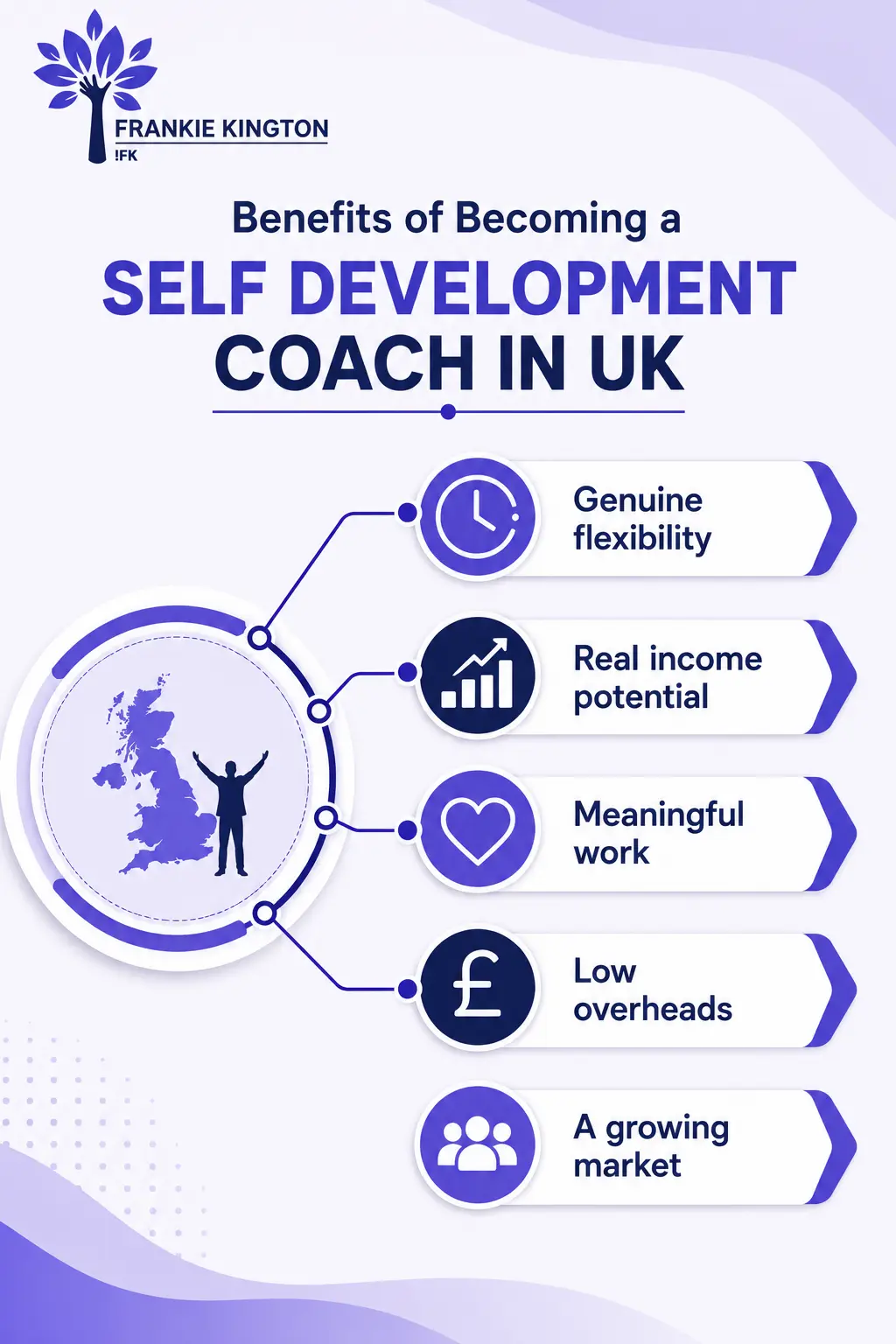
- Genuine flexibility: Most self improvement coaches set their own hours and work format, in-person, online, or a mix, particularly useful for coaches balancing this alongside other work early on.
- Real income potential: UK life and personal development coaches average around £30,000 to £32,000 a year, with experienced coaches earning considerably more through packages and specialization.
- Meaningful work: Watching a client move from stuck to genuinely confident is, honestly, the best part of the job.
- Low overheads: Coaching doesn’t require expensive premises or equipment, especially for coaches working online or from a home-based practice in Manchester or elsewhere.
- A growing market: Demand for personal development coaching has risen steadily as more people prioritize mental wellbeing and career clarity. Explore the role of a mental health coach and find out how personalized support can help you overcome challenges and reach your goals.
Skills You Need to Become a Self Growth Coach
Active listening sits above everything else. Clients need to feel genuinely heard, not just waiting for their turn to be told what to do.
Powerful questioning matters just as much. Good coaching draws answers out of a client rather than handing them down from above. Take the next step in your leadership journey with tailored leadership development coaching.
Beyond those two, a working self development coach needs:
- Empathy without losing objectivity
- Confidence to hold a client accountable, even when it’s uncomfortable
- Basic business skills, marketing, scheduling, invoicing
- Genuine self-awareness, since your own blind spots will show up in your coaching
- Resilience, since not every client relationship will go smoothly
Common Mistakes Self Development Coaches Make
Skipping proper training is the big one. Enthusiasm isn’t the same as skill, and clients notice the difference fairly quickly.
Trying to serve everyone is a close second. A coach who claims to help with confidence, career, relationships, and grief all at once often ends up mastering none of it. Learn how Frankie Kington’s Burnout Recovery Coaching in the UK can help you rebuild energy, set healthy boundaries, and regain work-life balance.
A few others worth naming:
- Undercharging out of fear, which often signals low value rather than accessibility
- No clear coaching structure: sessions that drift without a framework rarely produce real progress
- Neglecting their own development: coaches who stop working on themselves tend to stagnate
- Poor boundaries: answering messages at all hours burns coaches out fast.
Tools Every Self Growth Coach Needs in UK
A few practical tools make the day-to-day work considerably smoother.
- A booking and scheduling system, so clients can book sessions without a back-and-forth email chain.
- A simple CRM or client notes system, to track progress and goals across sessions.
- Assessment tools, wheel of life exercises, values assessments, or personality frameworks that help structure early sessions.
- A video conferencing platform, essential for coaches working with clients beyond Manchester and across the UK.
- Invoicing and payment software, since chasing payments manually eats into time better spent coaching.
Best Self Development Coaching Certifications in the UK
The International Coaching Federation remains the most globally recognized credentialing body, offering three levels, ACC, PCC, and MCC, each requiring progressively more training and supervised coaching hours, according to ICF’s official credentials overview.
|
Certification
|
Provider
|
Typical Time to Complete |
Recognition |
|
ACC
|
ICF
|
6-12 months
|
Entry-level, globally recognised |
|
PCC
|
ICF
|
18-36 months |
Mid-level, widely respected |
|
MCC |
ICF |
5-10+ years |
Highest level, rare |
|
EMCC accreditation
|
EMCC Global
|
Varies by provider
|
Strong in UK and Europe |
|
ILM coaching qualifications
|
ILM (City & Guilds)
|
A few months to a year
|
Common for workplace-based coaches |
For most new coaches, starting with an ICF-accredited Level 1 or Level 2 program, or an EMCC-accredited course, gives a solid, credible foundation without an unnecessary years-long commitment before taking on your first paying client.
FAQs
1. How much does a self development coach earn in the UK?
Somewhere between £25,000 and £45,000 a year for most. Specialize, or move into executive work, and that number climbs a fair bit higher.
2. Do you need a self development coaching certification?
Not legally, no. But clients and employers tend to expect one anyway, and it hands you frameworks that enthusiasm alone just can’t replace.
3. Do I need qualifications to become a personal development coach?
Nothing’s legally mandatory in the UK. Proper training still makes a real difference though, both to your actual skill and how credible you look to a new client.
4. Is self development coaching available online?
Very much so; it’s become the norm rather than the exception. Plenty of coaches here in Manchester work with clients right across the country and beyond.
5. How long does it take to become a certified self improvement coach?
Entry-level, three to twelve months usually. Something like ICF’s PCC or MCC is a different story entirely, years of accumulated coaching hours before you get there.
6. Can I become a self growth coach without quitting my current job?
Plenty of coaches do exactly that, building a client base part-time first. Honestly, it’s a sensible way to test the work before jumping in fully.
7. What’s the difference between a life coach and a self development coach?
Life coaching tends to range wider: career, relationships, direction generally. Self improvement coaching narrows in more specifically on growth, mindset, and habits.
8. Can a personal development coach also work as a confidence coach?
Often, yes, the two overlap constantly in practice. Low confidence is frequently the thing sitting underneath whatever’s actually blocking someone’s growth.
9. Do self-development coaches in Manchester work with clients outside the city?
Regularly. Most of us based here, myself included, work with people across the UK online and see local clients in person alongside that.
Final Words
None of this is complicated, exactly, but it does ask for real commitment, proper training, and enough self-awareness to keep working on your own growth while you’re guiding someone else’s. Manchester or anywhere else in the UK, the coaches who build something lasting are the ones who treat this as an actual skill worth developing, not a passion project that happens to have a website.
Exploring coaching yourself, or looking for a self-development coach UK-wide or right here in Manchester? I’d be glad to talk it through.